Past Events
-
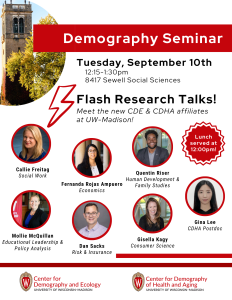 Sep 10DemSem: “New Faces Flash Research Talks”
8417 Sewell Social Sciences Building 1180 Observatory Drive Madison, WI 53706 DemSem full semester schedule
Speakers include Callie Freitag, Gina Lee, Gisella Kagy, Dan Sacks, Mollie McQuillan, Fernanda Rojas-Ampuero, & Quentin Riser.
-
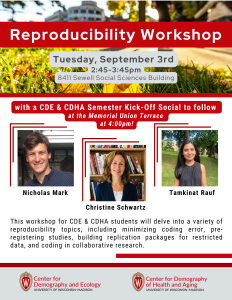 Sep 3Reproducibility Workshop
8411 Sewell Social Sciences Building
This workshop for CDE & CDHA students will delve into a variety of reproducibility topics, including minimizing coding error, pre-registering studies, building replication packages for restricted data, and coding in collaborative research. We invite all CDE & CDHA students, affiliates, and friends to a semester kick-off social following the workshop at the Memorial Union Terrace …
-
Jul 25RSS Reception in Honor of Glenn Fuguitt and Tom Heberlein
Agricultural Hall, 1450 Linden Drive
-
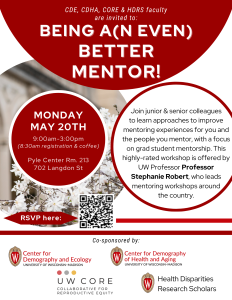 May 20Being A(n Even) Better Mentor ~ Faculty Training
Pyle Center Rm. 213, 702 Langdon St., Madison, WI
This event is co-sponsored by the Center for Demography & Ecology, the Center for Demography of Health & Aging, the Collaborative for Reproductive Equity, and Health Disparities Research Scholars. Join junior & senior colleagues to learn approaches to improve mentoring experiences for you and the people you mentor, with a focus on grad student mentorship. …
-
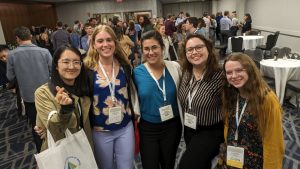 May 13Summer DemSem 2024
Day 1 2-4:35 pm @ 8417 Sewell Social Sciences with a reception to follow @ Tripp Commons balcony overlooking Memorial Union Reading list here. Day 2 9 am – 5 pm @ Pyle Center with breakfast beginning 8:30 am Program here. Please RSVP here.
-
May 13Climate Change, Aging, and Health Across the Life Course ~ 2024 Workshop
Pyle Center, 702 Langdon St., Madison, WI
Please find the full schedule here. This conference is supported by funding from the Research Centers Collaborative Network of the National Institute on Aging (NIA). This 1.5-day workshop aims to advance inquiry in climate change and health across the lifecourse. The workshop has four aims: (1) to share cutting-edge research on the effects of climate conditions …
-
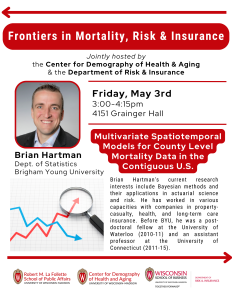 May 3Frontiers in Mortality, Risk & Insurance Seminar Series: Brian Hartman (Brigham Young University), “Multivariate Spatiotemporal Models for County Level Mortality Data in the Contiguous United States”
Grainger Hall Rm. 4151 (975 University Ave, Madison, WI) Full FMRI Seminar Series schedule
Brian Hartman’s current research interests include Bayesian methods and their applications in actuarial science and risk. He has worked in various capacities with companies in property-casualty, health, and long-term care insurance. Before BYU, he was a post-doctoral fellow at the University of Waterloo (2010-11) and an assistant professor at the University of Connecticut (2011-15).
-
 May 3CDE & CDHA 2024 Spring Research Event
AT&T Lounge at the Pyle Center, 702 Langdon Street, Madison, Wisconsin
The Center for Demography and Ecology and the Center for Demography of Health and Aging are pleased to announce we will be hosting our annual spring research event on Friday, May 3rd from 9:00-11:45 am in the AT&T Lounge at the Pyle Center. This workshop brings together faculty and student affiliates from across UW to …
-
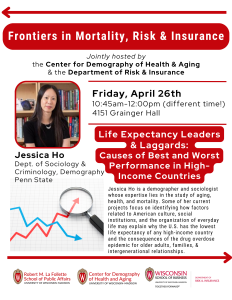 Apr 26Frontiers in Mortality, Risk & Insurance Seminar Series: Jessica Ho (Penn State University), “Life Expectancy Leaders and Laggards: Causes of Best and Worst Performance in High-Income Countries”
Grainger Hall Rm. 4151 (975 University Ave, Madison, WI) Full FMRI Seminar Series schedule
Jessica Ho is a demographer and sociologist whose expertise lies in the study of aging, health, and mortality. Some of her current projects focus on identifying how factors related to American culture, social institutions, and the organization of everyday life may explain why the U.S. has the lowest life expectancy of any high-income country and …
-
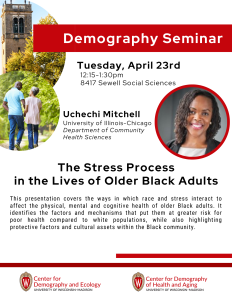 Apr 23DemSem: Uchechi Mitchell (University of Illinois-Chicago), “The Stress Process in the Lives of Older Black Adults”
8417 Sewell Social Sciences Building 1180 Observatory Drive Madison, WI 53706 DemSem full semester schedule
This presentation covers the ways in which race and stress interact to affect the physical, mental and cognitive health of older Black adults. It identifies the factors and mechanisms that put them at greater risk for poor health compared to white populations, while also highlighting protective factors and cultural assets within the Black community